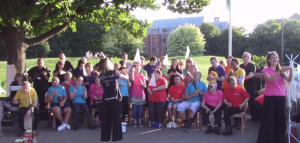
Meet Sarah and Jay
Sarah started as a singer and became a volunteer. Sarah loves the song Help by The Beetles. And Jay’s favourite is Don’t worry by Bob Marley. Jay plays percussion and sings.
Sarah said; “I also love our choir’s Kind Communication song as it tells people what we are all about.
For example, if people are talking to someone who is deaf or non-verbal, the song reminds them not to talk to the person behind or next to them – talk to the disabled person directly, otherwise it is not fair.”

Jay agrees; “The Kind Communication song reminds people not to judge a person on first impressions, but rather talk to them, make time for them and try to understand them.”
Their Include story…
Sarah first found out about The Include Choir through Facebook. She read about how Alix, a speech and language therapist, wanted everyone to be included…so she set up the choir for people without and with disabilities.
As Sarah says; “It’s called The Include Choir because it is just inclusive to everyone, there is no right or no wrong, everyone is the same in their different ways.

I was really nervous when I first started but another member Mary Clare took me under her wing and I was all okay. And if I’m ever down Nicola, one of the volunteers, will talk to me and cheer me up. I’d say to anyone that is thinking of joining the choir – don’t worry – give it a go!”
Sarah told Jay about the choir; “Sarah told me I would enjoy it. I can practice my singing, sign language, meet new people and just have a laugh! It also works well with supporting my speech…
…And (before Coronavirus) it meant I could spend time with Sarah outside of the house we live in”! Says Jay.
It might be time to reveal that Sarah and Jay have become a couple.
One of Sarah and Jay’s favourite Include Choir moments (and the favourite moment of many other members too) was them telling everyone in the choir that they had got engaged!
Saying connected through Covid19

“The Include Choir’s online activities during coronavirus help people who have mental health needs, use sign language or are on their own. The choir is a place they can come to spend time with other supportive people.” Says Jay.
I linked up with the choir during lockdown on Zoom and Facebook Lives. Communicating with the choir during lockdown gives me something to do during the day, especially if Sarah is not around, I have something I can focus on. And it is good seeing everyone else doing the same thing.”
Sarah agrees; “What’s nice is we can still communicate with people – it is just a bit different. We still celebrate people’s birthdays and sing Happy Birthday to them. I would feel quite down if we didn’t have Include in lockdown. I am not too bad at the moment as I can go to work – but the choir has kept me going before.” Says Sarah.

During the national lockdown earlier this year Sarah started an amazing initiative. She came up with an idea for The Include Choir to record a song to say Thank You to the NHS and other Key Workers. Click here to listen to the Thank You Key workers Song.
The choir sang and signed Jay’s favourite song “Don’t Worry” and it was shared online and even entered into a virtual talent competition! It gave the choir and the community a real boost.
Despite all the successes, Sarah has one eye on the future; “It was great when we could perform together – fingers crossed we can get back to it. It is a shame with Coronavirus. Online its good, but not the same.”
Final word from Sarah & Jay…
“The Include Choir helps us to help others…
The singing and signing are really helpful when communicating with people who are non-verbal. Says Sarah. We have a few people where Jay and I live who have brain injuries and are non-verbal and we can communicate with them. I show one of the boys our Include Choir videos and he loves it – we can make him happy and included by showing him Include Choir songs.

It helps me to communicate better at work too. I work with pre-school age children. I play with them, change their nappies, talk to them, feed them, keep them safe…and of course I can sing and sign with them!
When the community see us perform, I’m proud that we’re representing the choir and educating audiences about things like the Mental Capacity Act and how to support people like me who might have anxiety.”
Jay sums up; “Have a listen to us on YouTube and watch how we perform, that way you can learn about inclusive communication and perhaps donate some money to help us keep going?”


Communications, Fundraising and Partnerships Lead